
Northport Dental Marketing: Privacy-First, HIPAA-Safe Growth
September 2, 2025
Introduction
Northport healthcare and dental practices face a dual challenge in today’s climate: how to embrace modern Northport Dental Marketing to grow their patient base, while fiercely protecting patient privacy under HIPAA.
In this privacy-first world, both consumers and regulators expect you to handle personal data with care. The good news? With the right approach, you can implement effective marketing strategies – from SEO services that boost your online visibility to targeted PPC services – all while staying HIPAA-compliant and maintaining patient trust.
The Push for Privacy-First Marketing in Healthcare

We live in an age where privacy is front and center. Widespread data breaches and tighter laws have made the public more conscious of how their information is used. In fact, about 86% of consumers consider data privacy a significant concern.
In healthcare, this concern is even more pronounced – patients need to know their personal health information is safe.
For healthcare providers in Northport, a privacy-first marketing mindset isn’t just about avoiding penalties; it’s about building trust in the community. When people know you respect their data, they’re more likely to engage with your practice and recommend your services.
On a broader scale, digital marketing is only growing. Nearly 90% of healthcare executives expect digital engagement to increase in 2025, meaning strategies like online content, social media, and email outreach are becoming essential for growth.
However, this expansion comes with a catch: every new digital channel must be handled with privacy in mind.
Tech giants and browsers are also shifting – for example, Google’s evolving policies around cookies and user data mean marketers are adopting privacy-first tactics (like using first-party data and contextual ads) instead of invasive tracking.
The bottom line? Embracing modern marketing is key to growth, but it must be done in a way that prioritizes patient privacy from the start.
HIPAA Compliance 101 for Marketing (What Northport Practices Need to Know)
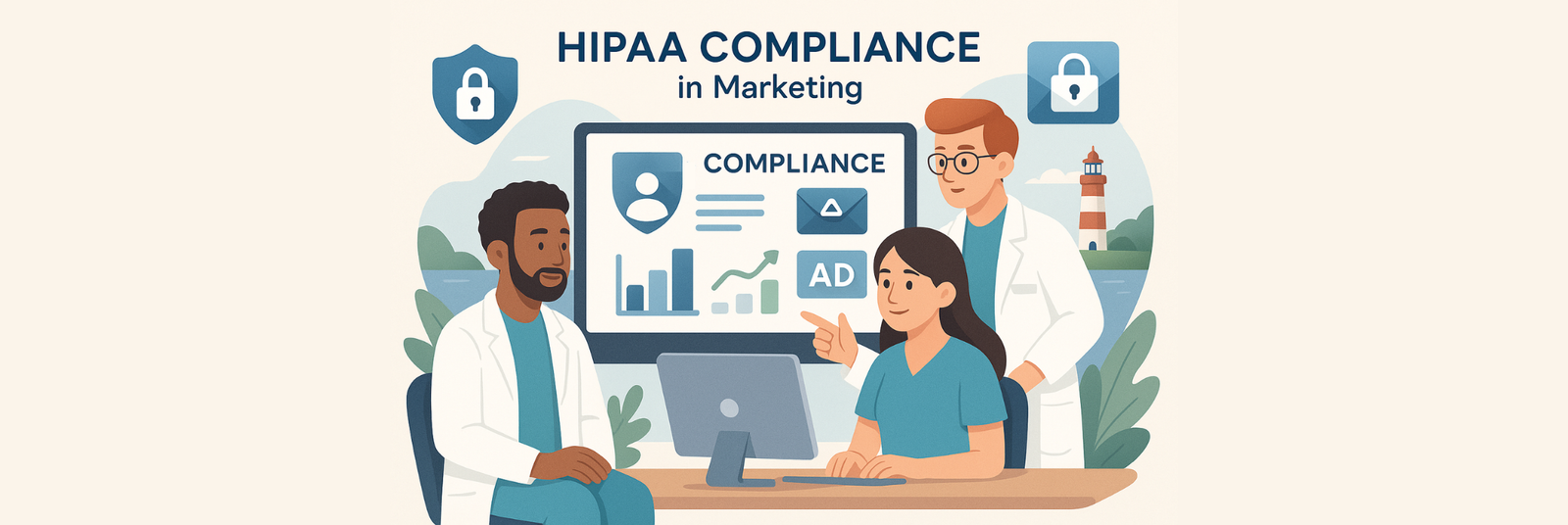
HIPAA – the Health Insurance Portability and Accountability Act – sets strict rules for how healthcare providers handle protected health information (PHI).
While HIPAA mainly governs medical records and clinical communications, it also extends to marketing when patient-identifiable data is involved. For any Northport medical or dental practice, it’s critical to understand how these rules impact your marketing efforts. Here are the basics:
1.What counts as PHI in marketing?
Any information that can identify a patient and relates to their health is PHI. This obviously includes names, contact info, appointments, or health conditions. But remember, PHI isn’t limited to medical charts – even a website visitor’s IP address combined with a health-related page view can be considered PHI under recent guidance.
For example, if someone visits a “Northport dental implants” page and your site’s tracking tools log their IP or email via a form, that data is protected by HIPAA. Bottom line: If your marketing collects or uses any identifiable patient data or even inference of health status, it falls under HIPAA rules.
2.Consent is key
Using patient information for marketing requires explicit patient authorization in most cases. You cannot automatically sign up patients for newsletters or use their testimonials in a Facebook post without written consent.
HIPAA’s privacy rule defines “marketing” communications and generally mandates opt-in authorization unless it’s about treatment or operations.
Always obtain clear permission – for instance, a patient filling a form can check an opt-in box for your newsletter, or sign a release form to allow their success story on your website. When in doubt, err on the side of caution and ask for consent in writing.
3.Business Associate Agreements (BAAs)
If you use any third-party vendors or agencies for marketing (email platforms, CRM software, digital marketing services providers, etc.), ensure they sign a BAA. A BAA is a legal contract where the vendor pledges to safeguard PHI in compliance with HIPAA.
For example, if you’re using an dental email marketing service to send appointment reminders or a marketing agency to manage your campaigns, they are considered “business associates” because they might handle patient data on your behalf.
You must have a BAA with them. Many popular tools – like standard Google Analytics, Facebook Ads, or MailChimp – will not sign BAAs, effectively meaning they are not safe for use with any real patient data.
Stick to tools that are willing to be HIPAA-compliant (some providers offer HIPAA-compliant versions or alternatives that sign BAAs). And if a vendor won’t sign a BAA, never input patient identifiers into their systems.
4.Train your team
Every staff member involved in marketing or communications should understand HIPAA basics. Make sure your front desk and marketing staff know that even a seemingly harmless act – like replying to a patient’s comment on social media – can breach privacy if done incorrectly.
Regular training is essential: cover what counts as PHI, what is off-limits to share, and how to handle inquiries or reviews without violating confidentiality. Creating a culture of privacy awareness in your team will greatly reduce accidental slip-ups.
In short, HIPAA compliance in marketing means building privacy into every campaign and tool you use. It might require a bit more planning – obtaining consent, using secure technologies, and educating your staff – but it’s non-negotiable for healthcare.
The reward is not just avoiding legal trouble, but also earning your patients’ trust by showing them you value their confidentiality.
The Risks Are Real: Consequences of Non-Compliance

Why go through all this trouble to align marketing with HIPAA? Because the stakes are extremely high. HIPAA violations aren’t just an IT issue; they directly affect your practice’s finances and reputation. Let’s look at what could happen if marketing isn’t privacy-compliant:
1.Step Fines & Legal Penalties
Regulators have shown they mean business when it comes to health data breaches. Even an unintentional privacy slip (for example, accidentally exposing patient emails in a marketing blast) can result in fines starting around $100–$50,000 per violation, up to an annual maximum in the millions.
For instance, as of 2025, an accidental violation can cost $141 per record at minimum, and a single case of willful neglect (where a serious issue is ignored) can incur up to $2.1 million in fines per year – not counting potential criminal charges for knowingly mishandling data.
These numbers aren’t theoretical: practices and companies have paid them. In early 2023, the FTC penalized a digital health company (GoodRx) for sharing users’ personal health queries with advertisers without consent, sending a clear message that improper data use in marketing will be punished. No Northport clinic wants to be the next headline for a privacy violation.
2.Data Breaches = Disaster
The healthcare industry consistently has the highest data breach costs of any sector. Recent reports found the average healthcare data breach costs around $10 million (when you factor in notifications, remediation, lost business, etc.).
While a small local practice might not face a breach of that magnitude, even a minor breach can be devastating.
For example, if your marketing inadvertently leaks a list of patients interested in a particular treatment, you could have to notify each patient, potentially face lawsuits, and suffer a loss of trust that you can’t put a price on.
Tens of millions of patient records are exposed each year in the U.S. through various breaches – you don’t want your patients to become part of that statistic due to a marketing oversight.
3.Reputation & Patient Trust
Perhaps the most irreparable damage from a privacy failure is the loss of trust. Health is a deeply personal matter. If patients feel you’ve mishandled their information, they may leave your practice and warn others. Negative publicity can spread quickly, especially in a close-knit community like Northport.
A cautionary tale: A few years ago, a Connecticut clinic was fined $125,000 after a doctor responded to a patient’s public complaint by revealing that patient’s health details to a reporter.
Not only was this a HIPAA violation, but imagine how that news impacted public perception of the clinic – patients likely wondered, “Will my doctor broadcast my info if I complain?” In the age of online reviews and social media, one privacy misstep can go viral for all the wrong reasons.
Maintaining compliance is essential to preserving your hard-earned reputation. Patients will choose a provider they can trust; showing you put privacy first is a powerful selling point in itself.
In summary, non-compliance is a risk you simply can’t afford – legally or ethically. Fortunately, avoiding these pitfalls doesn’t mean you must abandon marketing. It just means doing marketing the right way.
Let’s explore how you can actively grow your Northport practice with smart marketing strategies that keep you firmly within HIPAA’s boundaries.
HIPAA-Compliant Marketing Strategies to Grow Your Northport Practice

It is entirely possible to run effective marketing campaigns that attract new patients without ever compromising privacy.
As a marketing professional with 25 years of experience, I’ve seen that the most successful healthcare marketing plans are built on two principles: providing value to your audience and protecting their information.
Below are proven strategies and marketing services tactics that Northport healthcare and dental providers can use to grow — all designed with HIPAA compliance and a privacy-first approach in mind:
1. Optimize Your Website and SEO for Privacy & Visibility
Your website is often the first interaction a prospective patient has with your practice. A well-designed, informative site can convert visitors into appointments – but it also must handle user data responsibly.
- Ensure a Secure, HIPAA-Compliant Website: At minimum, your site should have an SSL certificate (your URL should start with https:// and show a padlock icon). Encryption is non-negotiable wherever users may input data. If you have contact forms (for appointment requests, newsletter sign-ups, etc.), use HIPAA-compliant form tools or plugins.
Avoid asking for unnecessary personal details on web forms – for instance, a simple “Request an Appointment” form might ask for name and phone number only, rather than detailed medical history.
Any patient data collected on the site should be stored securely (in a HIPAA-compliant database or CRM) and access-limited only to authorized staff. By building privacy into your site’s infrastructure, you make it a safe foundation for all your expert Northport dental marketing agency.
- Leverage SEO to Attract Patients Organically: Investing in SEO services (Search Engine Optimization) is a smart, privacy-friendly way to grow your reach. SEO is all about improving your website’s visibility on search engines for relevant queries (like “dentist in Northport” or “HIPAA-compliant telehealth Northport”).
It does not rely on personal patient data at all – instead, it uses quality content and keywords to draw in visitors naturally. This means you can boost your online presence without any privacy risk.
Consider creating a blog or resource section addressing common patient questions (e.g., “How to Choose a Family Dentist in Northport” or “5 Tips for Managing Diabetes – From Our Northport Clinic”).By providing valuable information, you’ll rank higher in search results and establish your expertise.
Local SEO is crucial too: keep your Google Business Profile up to date, encourage happy patients to leave reviews, and make sure your practice info (name, address, phone) is consistent across directories. These tactics help you connect with nearby patients who are searching for services – and none of it involves using protected data inappropriately.
In short, SEO and content marketing are foundational digital marketing strategies that let you grow awareness and credibility while staying safely within compliance lines.
- Protect analytics data: While analyzing your web traffic and marketing campaigns is important, be cautious with analytics tools. As mentioned earlier, standard analytics scripts can inadvertently collect identifiers like IP addresses that count as PHI if the person’s activity relates to health services.
If you use Google Analytics or similar, configure it to anonymize IPs and never use it on pages where patients log in or submit health info. Better yet, consider HIPAA-compliant analytics solutions or analytics via a server-side setup that filters out PHI.
The goal is to still gain insights (e.g., which pages are popular, how patients find you) but without exposing patient identities. Always consult with your IT or marketing provider on the compliance settings of any tracking code. Data is gold for marketing, but patient privacy is priceless – you can have both by being selective and careful with your analytics approach.
2. Run Privacy-Conscious Pay-Per-Click (PPC) Advertising
Paid advertising, such as Google Ads or social media ads, can quickly increase your visibility to potential patients in Northport and beyond. The key is to use dental PPC services in a way that doesn’t misuse patient data:
- Use targeting that doesn’t involve PHI: Platforms like Google and Facebook allow incredibly granular targeting – but in healthcare, you must restrain yourself from using any custom audience that involves patient lists or sensitive criteria.
For instance, do not upload a list of patient emails or phone numbers to target them with ads (this would be sharing PHI with the platform, which is not allowed since these platforms won’t sign a BAA).
Instead, use context and intent-based targeting. With Google Ads search campaigns, bid on keywords related to your services (“emergency dentist Northport”, “pediatrician near me”) – this way, your ads show when people are actively searching for care, not because you leaked their data.
On social platforms, you can target by location, age, general interests, or life stages, but avoid health condition targeting. Facebook, for example, has categories for interests in wellness topics – tread carefully and stick to broad categories if at all.
It’s often more effective to run ads based on geography (e.g., a radius around Northport) and general demographic (age, family status) than to risk any privacy violations.
- No PHI on ad creative or landing pages: It might sound obvious, but ensure your ad copy and images don’t inadvertently disclose someone’s info.
Use generic messaging (“Quality dental care in Northport – Book Today”) rather than something like “Hey [Name], time for your check-up!”. If you include testimonials or patient stories in ads, you must have consent from those individuals and word the content generally.
When users click your ad and land on your website, that page should be a secure, HIPAA-compliant environment just like the rest of your site.
Avoid third-party ad landing page tools that are not compliant; it’s best to keep everything within your own secured website. Also, as a rule, disable retargeting ads for pages where patients might submit health information.
Retargeting (showing ads to people who visited your site) is powerful, but after the 2022 HHS bulletin on tracking, using typical retargeting pixels on a healthcare site can be problematic if those pixels send data back to ad networks.
In essence, run ads that bring people to your practice, but don’t track them in ways that cross the line.
- Monitor and get legal approval if unsure: If you’re embarking on a new advertising tactic and aren’t sure about its compliance, get it reviewed by a legal or compliance expert. For example, some advanced campaigns might involve first-party data (like using your own website visitor data to create lookalike audiences).
There are some compliant ways to do this (such as analyzing patient data internally, then only using aggregate trends externally), but it’s easy to get into grey areas. When in doubt, have your campaign strategy vetted. A brief consultation can save you from a potential headache. Being safe is better than being sorry – or fined – when it comes to ad tactics.
3. Harness Email Marketing – Securely and Strategically
Email marketing is one of the most effective digital marketing channels for healthcare, if done right. It’s an excellent way to educate and stay connected with both current and prospective patients. In fact, healthcare email campaigns boast an average open rate of around 41%, which is among the highest across industries.
Patients do engage with useful content in their inbox, whether it’s a newsletter with wellness tips or a reminder about seasonal services. However, to maintain that trust and remain compliant:
- Use a HIPAA-compliant email platform: Regular email services (Gmail, Outlook, or basic versions of MailChimp, etc.) are not sufficient when sending messages containing PHI.
If you plan to send any emails that could include personal health details – for example, a follow-up note that references a specific condition or appointment – you must use a secure, encrypted email solution and have a BAA with the provider.
There are dedicated email marketing services for healthcare that make this easy, allowing encrypted bulk emails and even integration of PHI when necessary.
If your emails are more generic (e.g., a monthly wellness newsletter), you still should protect your mailing list and use a trusted email marketing service, but you might not be including PHI in content.
Either way, never send something like test results or individual advice over standard email; route those through a secure patient portal.
- Always get explicit opt-in consent: Only email people who have given you permission. This isn’t just a courtesy – under HIPAA, using patient emails for marketing without authorization can be seen as a privacy violation.
Include a checkbox on your intake forms or online forms where patients can choose to receive promotional emails or practice updates. Keep records of those consents.
And of course, always provide an easy unsubscribe option in every marketing email.
Not only is that required by general email laws (CAN-SPAM Act), but it’s part of respecting user choice and privacy. Patients who want out of marketing emails should be promptly removed from the list to avoid complaints.
- Watch the content of your emails: Even if someone consents to emails, you must still be careful about what you send.
Do not include sensitive personal details in the email body or subject line. For example, a subject like “Your upcoming oncology appointment on Aug 5” could be problematic if sent as a mass marketing email – it reveals the recipient is seeing an oncologist.
Instead, keep marketing emails broad: “Reminder: Annual Check-ups and Screenings – What to Know” or “New Service at Our Northport Clinic!”. If you need to convey personal information, direct the patient to a secure portal or have them call the office.
A common compliant strategy is to send a general message (like “We have new preventive care programs – contact us to learn more”), which encourages the patient to engage, without spilling any private info in the email itself.
Also, encrypt emails whenever possible, especially if there’s any doubt. Many compliant email services allow you to encrypt at the click of a button or will automatically do so if they detect certain keywords.
- Provide value, not just promotions: Privacy rules aside for a moment, a big reason people open healthcare emails is for useful content. As part of a privacy-first ethos, show patients that your emails are for their benefit, not just marketing.
Share educational tips (e.g., “5 Ways to Improve Dental Hygiene”), community updates (“Join us at Northport Health Fair this Sunday”), or general practice news. If you consistently deliver helpful information, patients are more likely to trust you – and by extension trust you with their data.
This builds goodwill and keeps them engaged with your practice. Engagement and trust go hand in hand; by respecting privacy and delivering value, your email marketing can strengthen patient relationships and encourage word-of-mouth referrals.
4. Engage on Social Media – Carefully and Professionally
Social media can be a powerful tool to humanize your practice and connect with the Northport community. Platforms like Facebook, Instagram, and LinkedIn allow you to share health tips, staff spotlights, patient testimonials, and more.
But remember: “Social media is a danger zone for health care workers,” as one medical center warned. The informality of social media can lull providers into oversharing – a big no-no under HIPAA. Here’s how to navigate social marketing safely:
- Never disclose PHI on social media: This seems obvious, but it’s worth stating emphatically. Do not post anything about a specific patient without written authorization.
This includes seemingly positive things like “So proud of [Patient Name] for beating addiction – they completed our program!” or even responding to a comment like “Thanks for the great visit, doc!” with “It was our pleasure treating you for [condition].”
The rule of thumb is: if a patient themselves posts details publicly, you STILL cannot confirm or elaborate on it. Always keep your responses general: “Thank you for your kind words! We’re here whenever you need us.” It’s perfectly fine to acknowledge feedback, just don’t reference any health specifics or even confirm the person is your patient.
Also, train whoever manages your social accounts to spot and remove any comments that might contain someone’s personal health info – occasionally patients might overshare (“That root canal last week was the best!”), and while that’s their choice, it’s safer to take conversations about care offline or into private channels.
- Share content that educates and builds trust: Great Dental social media marketing for healthcare focuses on helpful, non-sensitive information.
For example, a dental practice might post a video on “How to Properly Floss – Tips from Our Hygienist” or a pediatric clinic might share a graphic on “5 Common Winter Illnesses and How to Prevent Them.” These provide value and showcase your expertise without touching any individual’s data.
You can also highlight your team and facility (a photo tour of your clinic, introductions of new staff) – this personalizes your brand but doesn’t involve patient info.
Community engagement posts are wonderful too: share pictures from local events you participate in or health fairs you host in Northport, which underscore your community presence and goodwill.
- Obtain consent for testimonials or photos: Patient testimonials and success stories are powerful, especially for dental and medical services, but you must handle them properly.
If you want to post a patient’s before-and-after smile makeover picture, or a quote from someone who benefited from your physical therapy, get their written HIPAA authorization specifically for marketing.
Most patients who are happy to share will sign a release if you explain it helps others trust your practice. Have a standard form ready for this. And even with consent, be respectful in how you present the story – focus on the positive outcome and avoid overly specific medical details unless the patient is comfortable with it.
Also, be mindful of implied testimonials: if a patient tags your practice in a post or checks in on Facebook saying they’re at your clinic, that’s their choice, but you should not repurpose or repost it without permission. Always take a cautious approach: when in doubt, ask for consent or don’t share. - Stay professional and HIPAA-aware in direct messages: Patients might reach out via Facebook Messenger or Instagram DMs with questions. It’s best not to conduct detailed consultations or appointment scheduling via these channels, since they’re not HIPAA-secure.
Keep initial responses general: thank them for contacting you, then move them to a secure channel (“For your privacy, could you call our office or use our patient portal to discuss the details?”).
The same goes for any social media “chatbots” or automated replies – don’t solicit health info there. And absolutely avoid sending any PHI via social messages (no sending lab results or discussing a diagnosis in a DM!).
Use social media to open the door to communication, but then guide the patient to a phone call or secure email for anything sensitive. Your attentiveness to privacy, even on casual platforms, will show patients that you take their confidentiality seriously at all times.
- Regularly remind and train staff: If you have team members contributing to social media, establish a clear social media policy reflecting HIPAA rules.
It might outline things like: do not mention patients by name, do not share photos with patients in them unless authorized, what kind of comments are okay to respond to publicly, etc. Conduct refreshers because social trends change and new features pop up (for example, live videos, stories, etc.).
A quick huddle with your team, saying “Remember, if you film a quick video in the office for Instagram, make sure no patient information is visible on desks or computer screens in the background,” can save you from an accidental breach. Vigilance is key – social media moves fast, but you must slow down and double-check anything before it goes out.
When handled correctly, social media can amplify your reach and foster loyalty, without ever violating privacy. Many Northport residents likely scroll Facebook or local community groups for recommendations; having a positive, privacy-conscious presence there keeps you in the conversation and shows you’re a trustworthy provider.
5. Build Local Trust Through Community and Reputation Management
Local marketing isn’t just about online tactics – it’s also about how you engage with your community and manage your reputation. Northport is a community where word-of-mouth matters. By actively cultivating a trustworthy image both offline and online, you attract more patients in a HIPAA-compliant way:
- Participate in community events (with privacy in mind): Consider sponsoring or attending health fairs, school events, or local charity drives. These are excellent opportunities to meet residents and share your expertise in a friendly, non-clinical setting.
Just be sure that any health advice or screenings you offer on-site respect privacy. For example, if doing free blood pressure checks at a fair, have a somewhat private area and don’t shout out someone’s results. If people provide contact info to get more information later, treat those sign-up sheets as confidential records (lock them up and input into a secure system).
Community marketing is more about building relationships than collecting data. Even without collecting any personal details, your mere presence and helpful interaction at local events will make people more comfortable coming to you later. It’s marketing through service and visibility, with no privacy risk attached.
- Encourage (and respond carefully to) online reviews: Online reviews on Google, Yelp, Facebook, etc., are a modern form of word-of-mouth. Encourage satisfied patients to leave reviews – often a gentle reminder or a follow-up text with a link can increase your review count.
A strong rating builds trust with prospective patients who are researching you. However, when responding to reviews, be extremely mindful of HIPAA. It’s tempting to thank a reviewer and discuss their case (“So glad we could help you with your tooth extraction!”), but that would confirm they were your patient and had that procedure – not allowed.
Instead, use a generic but appreciative response: “Thank you for your feedback! We’re happy you had a positive experience at our office. – The Northport Dental Team.” If a review is negative, resist the urge to detail their visit or correct them publicly.
A compliant response might be: “We’re sorry to hear about your experience. Please contact our office so we can address your concerns directly.” This shows others that you care enough to resolve issues, but you’re not going to violate privacy in the process.
Prospective patients often read how a practice responds to criticism – a professional, HIPAA-compliant reply can actually impress readers and demonstrate your integrity.
- Highlight your privacy commitment in marketing: Let the community know that you take privacy seriously – this can be a selling point in itself. For instance, on your website’s About or FAQ page, mention that your practice follows strict HIPAA guidelines and values patient confidentiality.
In waiting rooms or brochures, you might share a short note about how you protect patient data (e.g., “Your privacy is our priority – our records are securely stored and we never share your personal health information without permission.”).
Some practices even include this messaging in their new patient packets. By explicitly stating it, you reassure current patients and signal to new ones that they can trust you not just with their health, but with their information.
Trust is the currency of healthcare marketing, especially in an era of data breaches. When patients trust you, they are more likely to refer friends and family, which organically grows your practice.
- Use marketing services experts when needed: If all these compliance details feel overwhelming, remember you don’t have to do it alone. Consider consulting with or hiring Northport dental SEO services or healthcare marketing who understand privacy regulations.
A seasoned marketing partner can help implement these strategies – from building a search-optimized, secure website to managing a compliant ad campaign – while you focus on patient care.
Just ensure any agency or consultant you work with is well-versed in HIPAA (ask them directly about their experience with healthcare clients) and, as mentioned, sign a BAA with them if they handle patient info.
Working with knowledgeable professionals can actually accelerate your growth safely, because they’ll know what pitfalls to avoid. As someone who’s been in marketing for decades, I often guide my healthcare clients through these privacy precautions second-nature.
We choose tactics that give strong ROI but won’t risk your practice. That expertise means you get effective marketing that lets you sleep at night, knowing you’re still compliant.
By focusing on community-centric marketing and robust reputation management, you effectively attract new patients through trust and good will.
These methods complement your digital strategy (SEO, ads, email, social) and create a holistic growth plan. Importantly, none of these require breaching patient confidentiality – they actually enhance your image as a trustworthy provider, which is the ultimate marketing win.
Conclusion: Thrive in Northport with Growth-Focused and Privacy-Focused Marketing
In today’s privacy-first world, excellent healthcare marketing is no longer just about creativity or budget – it’s about trust. Northport medical and dental practices that succeed will be the ones that can connect with people while safeguarding what matters most: their personal health information.
The strategies outlined above prove that you don’t have to choose between growth and compliance. You can leverage modern digital marketing services like SEO, PPC, and email outreach to expand your reach, as long as you implement them with HIPAA’s rules in mind every step of the way.
Staying HIPAA-compliant in marketing might require a bit more effort and vigilance, but it ultimately strengthens your practice. When patients see that you respect their privacy, it builds confidence and loyalty — priceless assets for any growing practice.
By focusing on education, consent, secure technology, and transparent communication, you create a marketing game plan that not only brings in new patients but also keeps your current patients feeling safe and valued.
Remember, effective marketing is really about building relationships. And every strong relationship, especially in healthcare, is built on trust. As you promote your services and share your story in Northport, make privacy protection part of your story.
Your practice will stand out as both cutting-edge and caring – a provider that embraces innovation while honoring the oath to do no harm, including to patient confidentiality.
Frequently Asked Questions (FAQs):
Q1. What is the connection between HIPAA and healthcare marketing?
A: HIPAA sets rules for how healthcare providers handle protected health information (PHI). This directly impacts marketing when patient-identifiable data is collected or used, such as through website forms, email lists, or third-party advertising services.
Q2: Is it safe to advertise on Google or Facebook given HIPAA regulations?
A: It is possible to advertise on major platforms like Google and Facebook in a HIPAA-compliant way, but you must be very careful with how you set up campaigns.
These platforms themselves are not HIPAA-compliant (they won’t sign BAAs), so the onus is on you to avoid transmitting any PHI to them.
This means: do not use patient lists or any identifying health information to target your ads. Instead, rely on general targeting (keywords, location, non-health demographics) as discussed in the PPC section above. Also, ensure any landing pages your ads lead to are secure (HTTPS) and avoid embedding tracking pixels that could send patient-related data back to ad networks.
You should not be doing things like dynamic ads that insert a person’s name or condition, as that would involve PHI. If you stick to broad audience targeting and keep the content general, you can still reach the right people (e.g., locals in Northport looking for a healthcare provider) without violating privacy.
In short, you can absolutely use online ads to grow your practice – just run them in a privacy-conscious manner, and when in doubt, consult with a compliance expert on your ad setup.
Q3.What are the rules for using patient testimonials on social media under HIPAA?
A: To use a patient’s testimonial or photo for marketing, a healthcare practice must obtain explicit written authorization from the patient. Even if a patient posts a positive review publicly, the practice cannot confirm the patient-provider relationship or share any details about their treatment in a public response.
Q4. How does a healthcare practice ensure its website is HIPAA compliant?
A: A compliant website must use SSL encryption (HTTPS), employ HIPAA-compliant forms for collecting data, and securely store any collected patient information. It is also essential to be cautious with analytics and tracking tools that might inadvertently capture PHI.
Q5: What is a Business Associate Agreement (BAA) and do I need one with my marketing vendors?
A: A Business Associate Agreement is a contract between a healthcare entity (like your practice) and any outside vendor that might handle protected health information on your behalf.
It obligates the vendor to follow HIPAA’s security and privacy rules just as you would. In the context of marketing, you need a BAA with any service provider who comes in contact with patient data.
Examples include an email marketing platform that stores your patient email list, a marketing agency that has access to your appointment records to run a campaign, a customer relationship management (CRM) software where you track leads and patients, or even a cloud hosting service for your website if patients submit forms there.
By signing a BAA, the vendor agrees to safeguard the data (with encryption, access controls, etc.) and to report any breaches. If a vendor refuses to sign a BAA (common with some big tech companies), that’s a red flag that you shouldn’t be using patient data in conjunction with their service.
In those cases, you either find a HIPAA-compliant alternative or use the tool in a limited way that never involves PHI. The BAA is essentially your safety net and proof that your partners are on the hook for protecting privacy too.
Always ask your vendors about HIPAA compliance and get that BAA in place before sharing any patient information. It’s a standard practice in healthcare industries now and a crucial step in maintaining comprehensive compliance.
Dental Marketing Agency in Sylacauga: Should You Hire?
Introduction For a dental practice in Sylacauga, standing out can...
Forecasting With Data: How Predictive Tools Help Selma Dentists Plan Staffing & Growth
Introduction In today’s data-driven world, even dental practices are discovering...
Ads for Dental in Scottsboro: Book More Local Patients
Introduction For over 25 years, I’ve watched marketing trends come...
AI Content in Dentistry Saraland: Save Time & Stay Authentic
Introduction Artificial intelligence is making waves in AI Content in...
Omnichannel Dental Marketing in Prichard: Reach Every Patient
Have you ever noticed an ad for a product seemingly...








2025 ALL RIGHTS RESERVED MADE IN INDIA
